How Water Damage Drying Works
This guide explains what the air movers and dehumidifiers in your home are doing and why the drying takes several days.
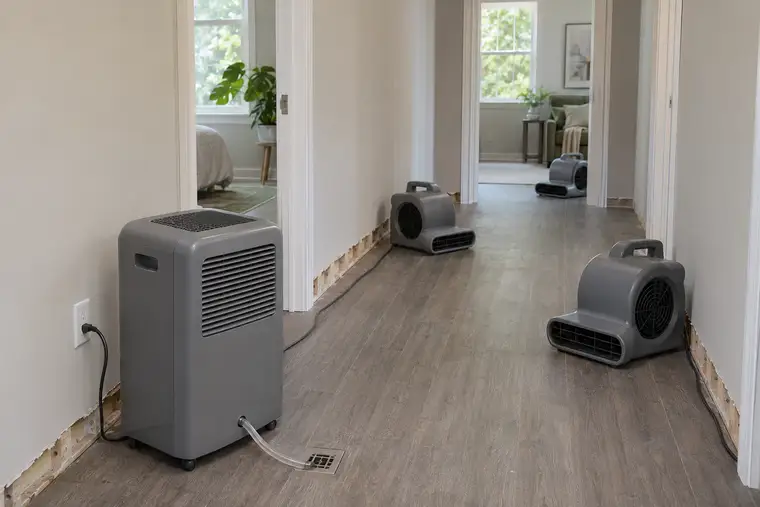
How water leaves a wet house
First water turns from liquid into vapor, then the vapor is pulled out of the air.
Wet materials only dry when the water in them evaporates. That happens faster when the air moving over them is warm and dry. Once the water is in the air, it has to go somewhere. If it stays in the room, it settles back into the walls and floors. A dehumidifier is what takes it out for good.
That is how water damage drying works in every house. Every piece of equipment you see is doing one of those two jobs, either helping water evaporate or pulling the vapor out of the air. Knowing that makes the equipment easier to understand.
How water damage drying works, machine by machine
Extractors
Extractors pull standing and soaked water out of carpets and floors. The more that comes out as liquid, the less needs evaporating.
Air movers
These low, powerful fans sweep damp air off wet surfaces so fresh air can pick up more moisture.
Dehumidifiers
They draw air through cold coils or a drying wheel, take the water out and send back drier air.
Time
Time is the fourth part of drying, because each material gives up water at its own pace.
Where the drying equipment is placed and why
The placement looks random but follows a pattern. Air movers point along the base of the walls, so the air rolls across the lower drywall where the water wicked highest. Dehumidifiers sit where they can draw air from the whole wet area.
- Air movers spaced along wet walls, angled in the same direction so the air circulates.
- Carpet sometimes lifted at one edge so air can float it and dry the pad and subfloor.
- Small holes behind the baseboard to blow air into a wall cavity.
- Plastic sheeting to close off a drying zone so the dehumidifier works on a smaller space.
What different materials need
| Material | How it dries | Typical pace |
|---|---|---|
| Carpet and pad | Fast once extracted, the pad is often replaced | A day or two for the carpet |
| Drywall | Gives up water fairly readily | Two to four days |
| Framing and subfloor | Slower, the water sits deep in the wood | Three to five days or more |
| Hardwood floors | Slowly and carefully, to avoid cracks | A week or more |
| Concrete | Holds a lot of water and releases it slowly | Often the longest |
| Plaster | Dense, dries slowly and evenly | Longer than drywall |
These are rough guides. Each house, each leak and each week of weather is different. A small leak caught within hours may dry in a couple of days, while a lower level that sat wet over a weekend can take far longer. The readings decide.
Daily moisture checks during drying
Daily checks are a big part of how water damage drying works, because drying is measured rather than assumed. A technician visits regularly, often daily, and takes readings at the same points each time.
Readings at marked points
Readings are taken at the same spots on walls and floors every visit, so the numbers can be compared.
Room humidity and temperature
These show whether the air is dry enough to keep pulling water out.
Move or adjust equipment
As areas dry, machines are moved to the places that are still wet.
Note the progress
A simple log shows how each spot is changing day by day.
Each visit ends with an update on what dried, what is still wet and what happens next, so you are never guessing.
Drying in damp weather
Opening windows only works when the air outside is drier than the air inside.
For much of the year in Redmond, it is not. Long rainy seasons mean outside air carries plenty of moisture of its own. Keeping the house closed and letting the dehumidifiers do the work is usually faster. A steady, comfortable indoor temperature helps too.
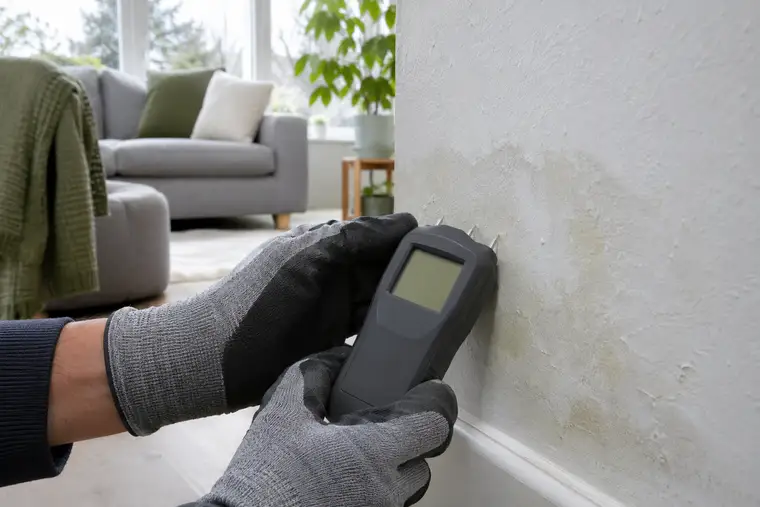
How you know the drying is finished
The last part of how water damage drying works is the proof. The house is dry when the readings in the wet areas match the same materials in rooms that never got wet. It is not finished just because it feels dry or because a set number of days has passed.
- Final readings at every marked point.
- A comparison with the dry reference readings.
- A note of anything removed and why.
- Only then do repairs like drywall, paint or flooring begin.
Drying shortcuts that cause problems
Running heaters on high
Heaters dry the surface fast and crack wood while the inside stays wet.
Switching off at night
Switching the equipment off lets damp settle back in and adds days.
Closing walls early
Closing a wall early seals water inside, where mold can grow.
Moving the machines
Moving a machine shifts air away from the spot that needs it.
How walls and subfloors are dried
The hardest water to reach is the water you cannot see. Wall cavities, the space under cabinets and the subfloor below a finished floor all hold water behind a surface that may already feel dry.
Open a path for air
Air reaches the cavity through small holes behind the baseboard, a removed toe kick or a lifted carpet edge.
Push air into the space
Air movers or small injection hoses send dry air into the cavity.
Pull the damp air away
Dehumidifiers in the room capture the moisture as it comes out.
Measure inside, not just outside
Probes and readings check the cavity as well as the surface.
Drying questions
How long does water damage drying take?
Most rooms take three to five days. Hardwood, concrete and crawl spaces often take longer.
Why does the equipment have to run all night?
Turning it off lets the humidity rise again, and water moves back into the materials. Running nonstop finishes the job sooner.
Can I move the air movers?
Best not. They are placed to push air across specific wet areas. Moving them can leave those areas wet.
Why is the room warmer than usual?
Dehumidifiers and air movers give off heat. Warmer air also helps water evaporate.
Do I need to empty the dehumidifier?
Professional units usually pump water into a sink or a drain. If yours has a container, the technician will explain.
What happens if it rains during drying?
Nothing changes inside if the house stays closed. The dehumidifiers keep working regardless of the weather.
Can a house be too dry?
Wood can shrink if it is dried well past normal. That is why readings are compared with dry rooms and the drying stops at the right point.
Is it safe to sleep with the machines running?
Yes, though they are noisy. Many people sleep in another room, with the door closed, until drying ends.
Why does a technician keep coming back?
To take readings at the same points, move equipment to the areas still wet and decide when each area is done. Drying without measuring is guessing.
Will the air movers damage my walls or floors?
No. They move air, nothing more. Keep cords tidy and avoid tripping over them, and let the technician move them if a room needs to be used.
Why are some rooms dry sooner than others?
Each room has different materials and different amounts of water. Tile and drywall dry faster than wood floors, concrete or a crawl space.
Can drying start before the leak is repaired?
The source has to be stopped first, even if a permanent repair comes later. Drying a house while water is still coming in only wastes time.
What does the dehumidifier collect?
It is water pulled out of the air and, through the air, out of your walls and floors. The amount it collects each day is one way to see the drying slow as the house dries.
Do I need to keep doors closed?
Keeping the doors to the drying area closed helps the dehumidifier work on a smaller space. The technician will tell you which doors to keep shut.
Can the drying be done without lifting carpet?
Sometimes. Clean water carpet can often be dried in place with extraction and air movers. Lifting a corner helps reach the pad and the subfloor when needed.
Why do the readings sometimes go up?
A reading can rise for a day if water moves from a wetter part of a material toward the surface, or if a hidden source is still leaking. A rise that continues means something needs a closer look.
Does furniture slow the drying?
Furniture against a wet wall or sitting on a wet floor blocks the air. Moving it, or lifting it on blocks, lets the equipment reach the surfaces that need it.
Where drying fits in each service
- Water removal and dryingThe full job from extraction to final readings.
- Drying to stop moldWhy finishing the drying prevents mold.
- Wet hardwood floorsWhy wood floors need slower drying.